Vulnerability Snapshot
This advisory is rated HIGH — exploitation is straightforward for a motivated attacker and impact is significant. Apply the vendor patch within your standard high-severity SLA.
Executive Summary
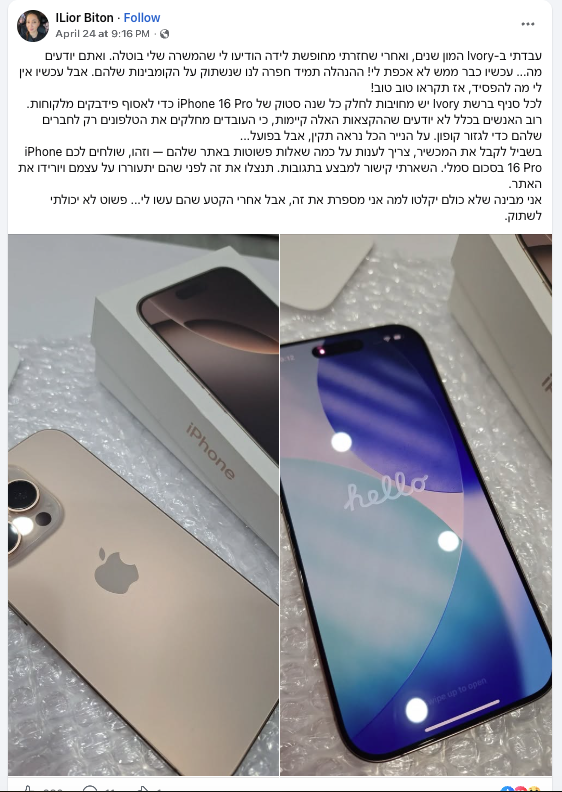
A phishing campaign is actively targeting users via Facebook-sponsored content, redirecting victims to a malicious website that impersonates Ivory and offers discounted iPhone 16 Pro devices.
The campaign uses a Facebook redirect link (l.facebook.com) to mask the final destination and increase user trust, leading to the domain:
* Malicious domain: top-rewards[.]online
Attack Flow
* Credit card details
* Personal information
Indicators of Compromise (IOCs)
* top-rewards[.]online
* Facebook redirect pattern: l.facebook.com/l.php?...
* Unrealistic discounts on high-demand products (iPhone 16 Pro)
* Urgency messaging (“limited offer”, “act now”)
Key Risks
* Financial fraud – direct theft via payment details
* Identity theft – collection of personal information
* Brand abuse – impersonation of trusted retailers (Ivory)
* Trust bypass – leveraging Facebook infrastructure to appear legitimate
Why This Works
* Users trust Facebook-hosted links
* Strong brand impersonation increases credibility
* Mobile users are less likely to inspect full URLs
* Psychological pressure drives fast decisions
Recommendations
For Users
* Avoid clicking on promotional links from social media without verification
* Always navigate to official websites manually
* Never enter payment details on unfamiliar domains
For Organizations
* Monitor for brand impersonation campaigns
* Implement threat intelligence feeds to detect malicious domains
* Educate users about social media phishing risks
AI Security Advisor
Powered by Gemini
Get AI-powered security recommendations tailored to this specific threat — including risk assessment, detection guidance, MITRE ATT&CK mapping, and actionable remediation steps.
Sources
Related Threat Alerts
- AI Agent Deletes PocketOS Production Database in 9 Seconds
- 🏴☠️ Lockbit5 has just published a new victim : bladex.com
- 🏴☠️ Lockbit5 has just published a new victim : studiopiu.net
- 🏴☠️ Lockbit5 has just published a new victim : bardehle.com
- 🏴☠️ Lockbit5 has just published a new victim : murni.co.id
- 🏴☠️ Lockbit5 has just published a new victim : heinrichs-logistic.de
Frequently Asked Questions
What is "Fake Ivory iPhone Campaign Uses Malicious Domain to Steal Payments via Facebook Redirect"?
This is a high-severity threat update from an upstream security source. It covers the affected product family and was flagged for security teams to evaluate.
Am I affected?
Affected technology is listed in the Affected Products section above. If your asset inventory contains any of them, assume in-scope until you can prove otherwise.
How urgent is the response?
High: address inside your standard high-severity SLA (typically 7 days for internet-exposed assets, 30 days for internal). Skip ahead in the queue if the host is internet-facing.
How do I remediate?
Apply the vendor patch listed in the upstream advisory linked under Sources. If the patch is not yet available, follow the vendor-supplied workaround (often a config flag or feature disable) and add detections for the published exploit pattern in your SIEM. Re-scan after the patch lands to confirm the finding clears.
How does Vulnios help with this?
Vulnios continuously cross-references your asset inventory against the live CVE feed (NVD, vendor advisories, CISA KEV, and curated OSINT). When a new CVE matches your environment, you get a prioritized finding with the severity, KEV status, exploit-prediction (EPSS), and a direct path to the vendor patch. You can start a free scan from the homepage.
Protect Your Organization
Monitor CVEs, scan for vulnerabilities, and get real-time threat alerts — all in one platform.
Weekly threat digest
KEV-listed exploits and vendor advisories, every Monday.
One email a week. Unsubscribe any time.
Get instant alerts on Telegram
Join our public channel for real-time critical CVE alerts.
Follow @vulnios